Oguzhan Kirik Robotics Research

Projects

Six recent projects trace a line from foundation models and imitation learning to language-conditioned manipulation, perception pipelines, and reinforcement-learning environments for robots.

OpenVLA Evaluation for Language-Conditioned Pick-and-Place

A compact evaluation study of OpenVLA on tabletop manipulation prompts involving the same object under different spatial contexts. The GIF shows six successful trajectories with instruction-specific scenes, covering retrieval from the top drawer, ramekin, cookie-box, stove, plate, and cabinet settings. The result highlights how a generalist vision-language-action model can stay responsive to changing natural language instructions while preserving coherent pick-and-place behaviour across layouts.

OpenVLA Vision-Language-Action Evaluation

Selected evaluation montage assembled from six successful OpenVLA rollouts recorded on March 8, 2026, each labeled by instruction context.
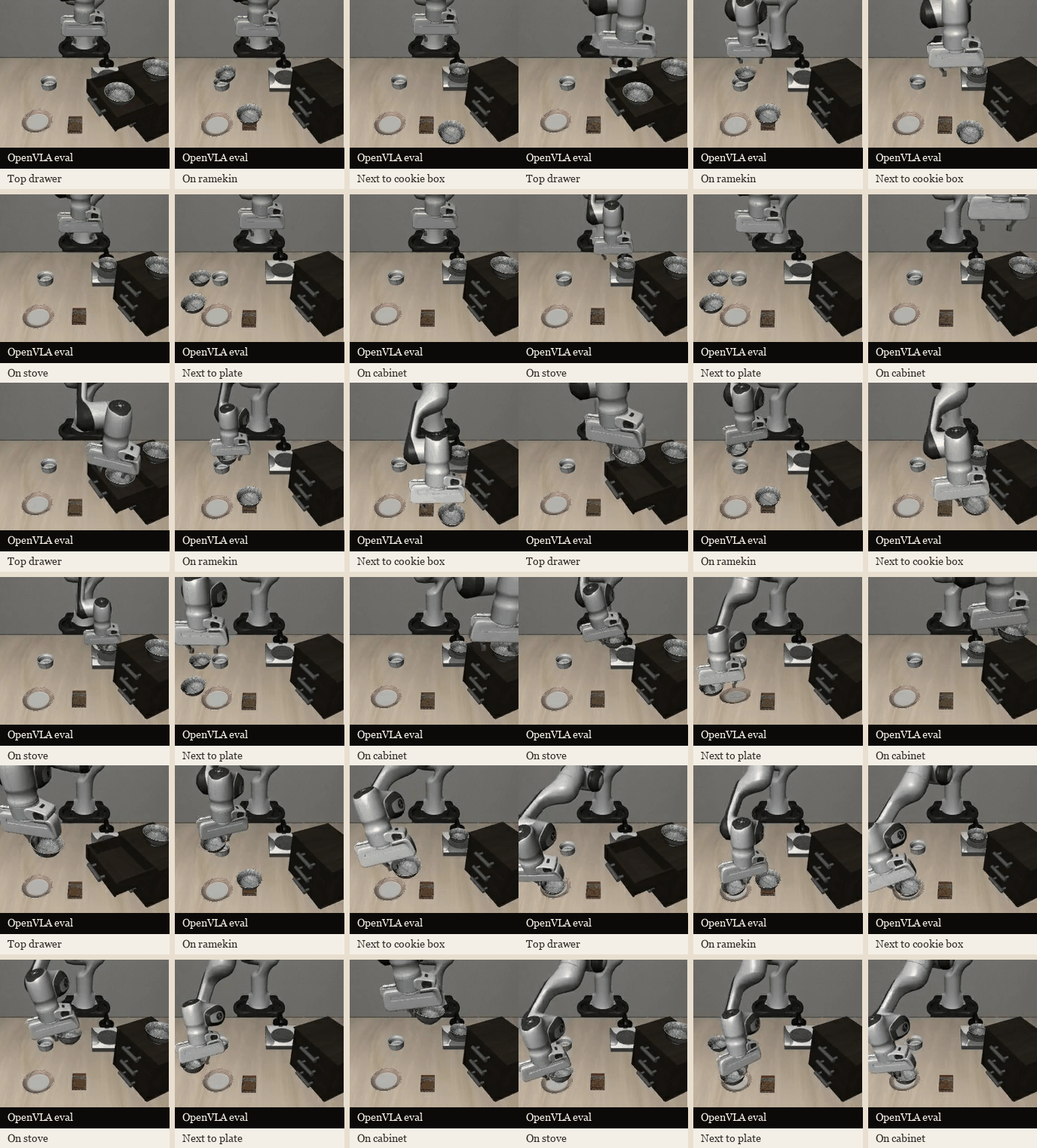
Animated six-panel OpenVLA evaluation montage showing pick-and-place tasks under different instruction contexts

Diffusion Policy for Robotic Stacking

An exploration of diffusion-policy-based imitation learning for robotic stacking using LeRobot and the Unitree G1 Dex3 Block Stacking dataset. The work tests how recent policy-learning methods transfer to a practical manipulation setup, with early results suggesting strong task performance and a promising path toward task-specific robot training from self-generated data.

Imitation Learning Manipulation LeRobot

Post: Oguzhan Kirik, Diffusion Policy for robotic stacking with LeRobot and the Unitree G1 Dex3 Block Stacking dataset , LinkedIn, March 2, 2026.

HOT3D Egocentric Object Detection Benchmark

A side-by-side comparison of three object detection models on the HOT3D dataset, an egocentric benchmark for 3D hand-object interaction captured from a first-person view. The sequence highlights why this setting matters for human-robot collaboration: a robot observing egocentric video can track which objects a person is picking up, handing over, or manipulating, and use that signal to react in real time. The comparison contrasts Faster R-CNN (ResNet-50) as a strong two-stage baseline, RF-DETR Medium as an end-to-end transformer detector, and YOLO12l as a low-latency single-stage model for real-time deployment.

HOT3D Object Detection Human-Robot Collaboration

The combined video makes it easier to compare detection quality, bounding-box stability, and inference responsiveness across the three models in the same egocentric scene.

LAVA for Language-Conditioned Manipulation

A language-conditioned robotics project from our lab at TU Berlin, where we trained a LAVA policy on the Google Language Table dataset and deployed it on a UR5 robot for tabletop manipulation. The system maps camera observations and natural language instructions to robot actions, enabling tasks such as pushing, placing, and arranging objects directly from written commands.

Language Table UR5 VLA

Citation: Corey Lynch, Ayzaan Wahid, Jonathan Tompson, Tianli Ding, James Betker, Robert Baruch, Travis Armstrong, and Pete Florence. Interactive Language: Talking to Robots in Real Time. arXiv:2210.06407, 2022.

Sensor Fusion and UKF-Based Multi-Object Tracking

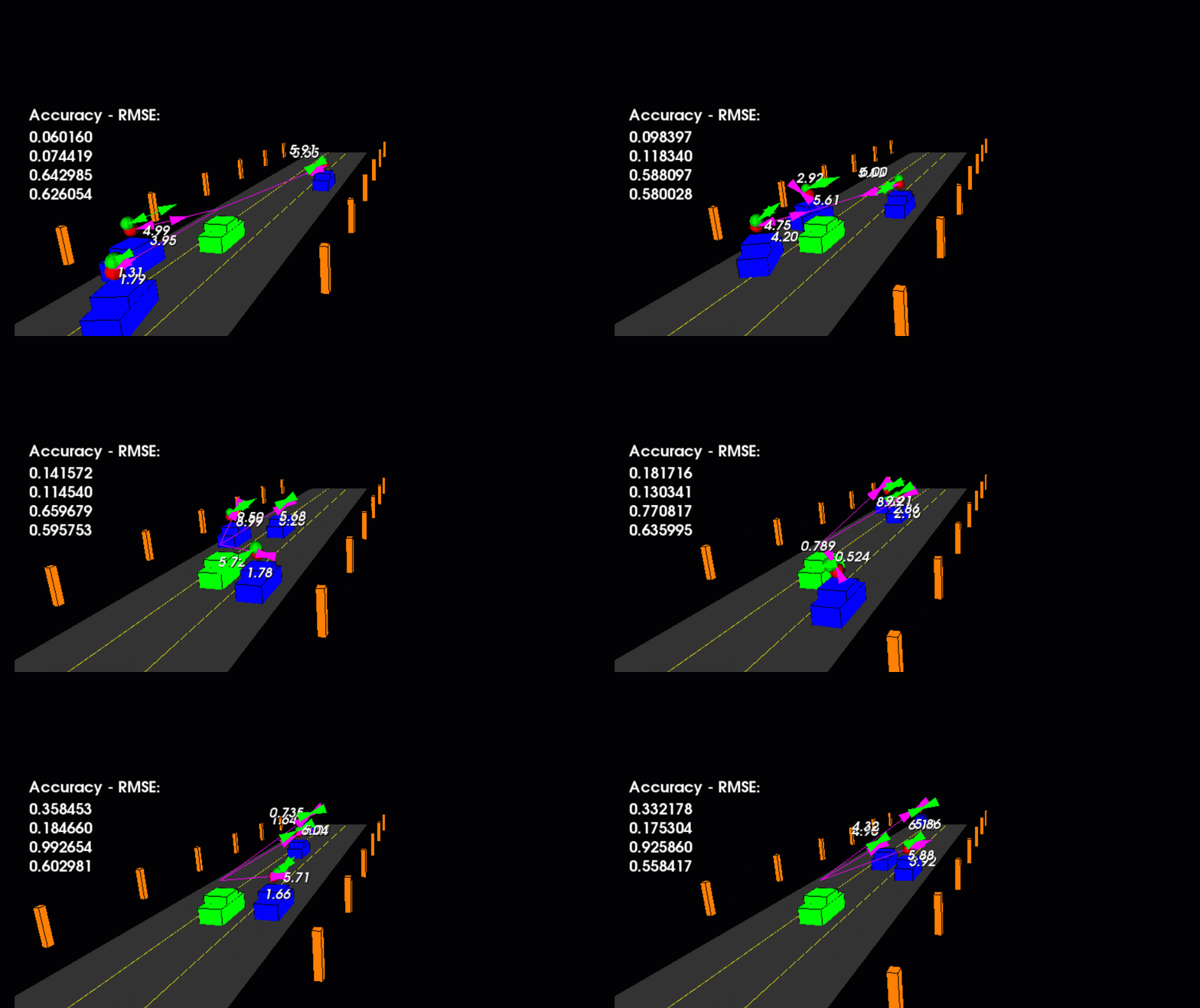
A perception-focused project built to revisit sensor engineering fundamentals from the ground up, combining lidar obstacle detection, radar signal processing, camera-based TTC and feature tracking, camera-lidar fusion, and KF, EKF, and UKF-based real-time tracking. The implementation brings these pipelines together into a single repository using C++, Python, MATLAB, PCL, and OpenCV for end-to-end scene understanding.

Perception Sensor Fusion Tracking

Post: Oguzhan Kirik, Unscented Kalman Filter (UKF) multi-object tracking using lidar and radar , LinkedIn, February 2, 2026.

Sensor fusion and UKF-based multi-object tracking project preview

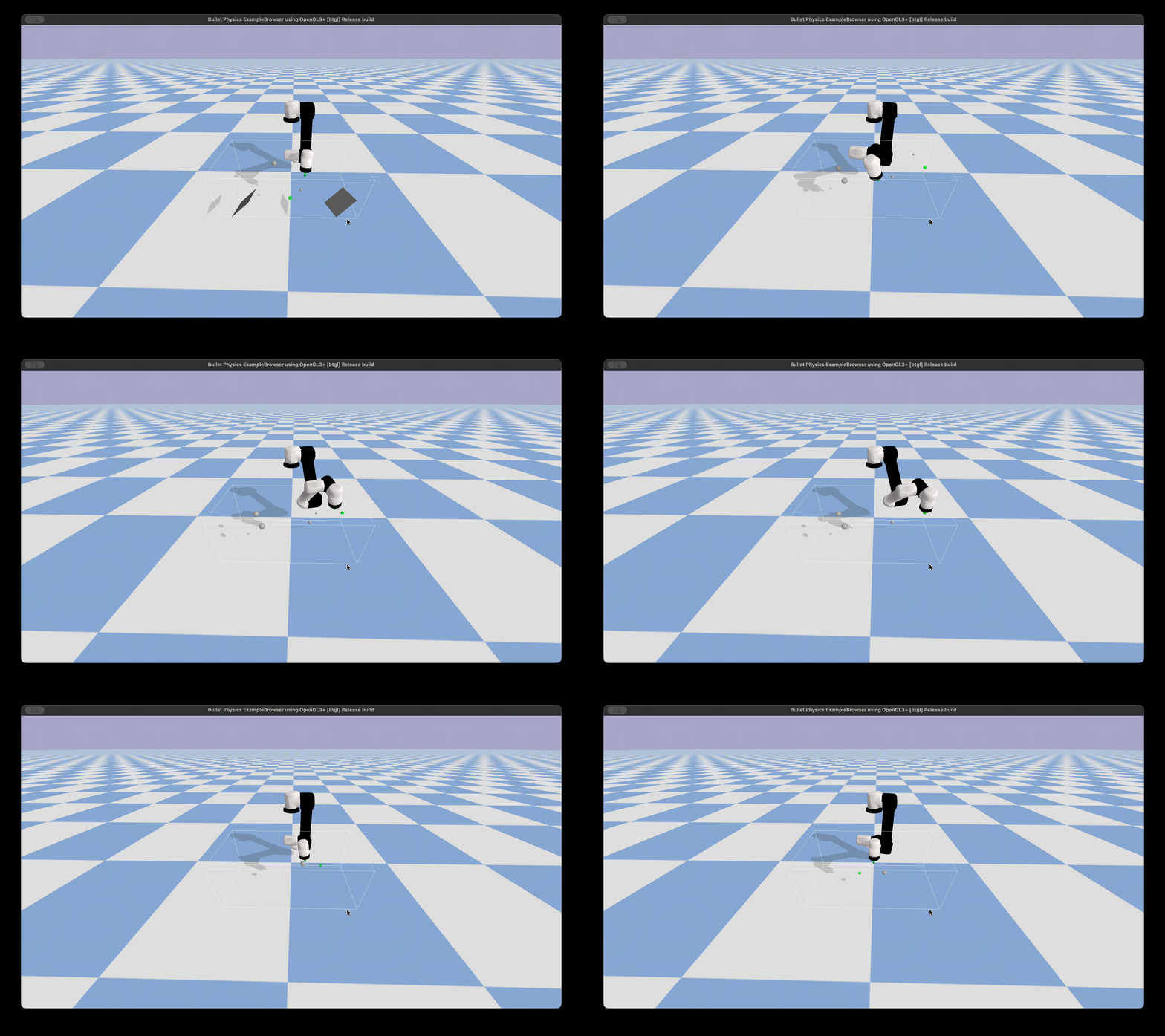
Modular DRL Gym Env for Robots with PyBullet

A modular deep reinforcement learning framework for robotic path planning and manipulation in PyBullet, built around configurable robots, goals, and sensor setups. The project also includes a sim-to-real deployment pipeline using ROS and voxelized perception so trained policies can transfer to real robot environments with static and dynamic obstacles.

Reinforcement Learning PyBullet Sim-to-Real

Citation: Teham Bhuiyan, Linh Kastner, Yifan Hu, Benno Kutschank, and Jens Lambrecht. Deep-Reinforcement-Learning-based Path Planning for Industrial Robots using Distance Sensors as Observation . arXiv:2301.05980, 2023.

Evaluation GIF showing the DRL robot planner navigating around obstacles
About Me

Robotics and AI engineer working across automation, robot learning, and machine vision for intelligent robotic systems.

I am based in Berlin and work at the intersection of robotics, perception, and AI deployment. My experience spans research and engineering roles at Technical University Berlin, Relimetrics, KIT, ZKM, and INVITE, alongside independent work on early-stage robotics ventures. Across these roles I have built and deployed systems for robot manipulation, path planning, sensor fusion, predictive maintenance, industrial automation, and real-world experimentation.

My academic background is in mechanical engineering with a robotics track: an M.Sc. in Mechanical Engineering with a major in Robotics and Mechatronics from Karlsruhe Institute of Technology, a DSH-2 German course at the University of Wuppertal, and a B.Sc. in Mechanical Engineering from Yildiz Technical University. I am particularly interested in adaptable robot behavior, vision-language-action models, reinforcement learning, and practical systems that connect research prototypes to deployable products.

Education and Focus

My training in mechanical engineering and robotics is paired with hands-on work in AI-driven automation, robot manipulation, perception, and autonomous systems. That combination shapes a research direction centered on reusable robot skills, language-conditioned control, and robust deployment beyond controlled lab settings.

Research Interests

The broader agenda stays close to robot capability, transfer, and interpretability across different task regimes.

  • Adaptable skill learning for robotic manipulation and control
  • Vision-Language-Action models for embodied agents
  • Reinforcement learning for long-horizon and compositional tasks
  • Generalization, transfer, and robustness in robot learning